Lab / Lab 04
Beaumont Records
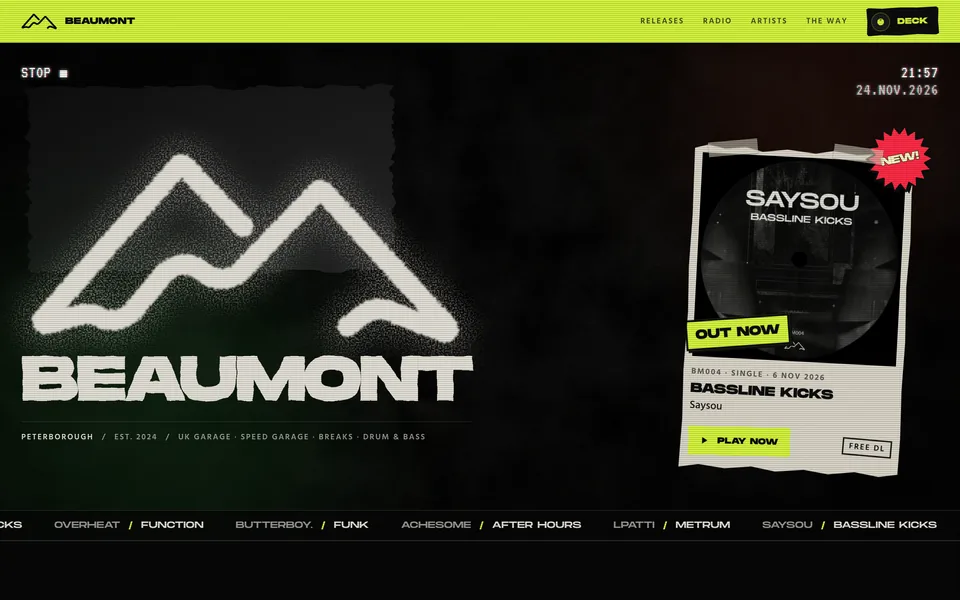
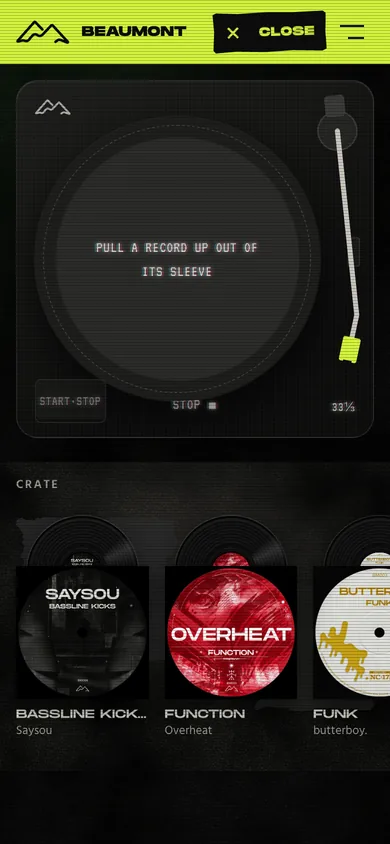
The website for Beaumont, the drum & bass and jungle label I'm part of. I designed and art-directed it, and agents wrote the code. It has a player that stays with you as you browse, and a turntable you can actually play.
The brief
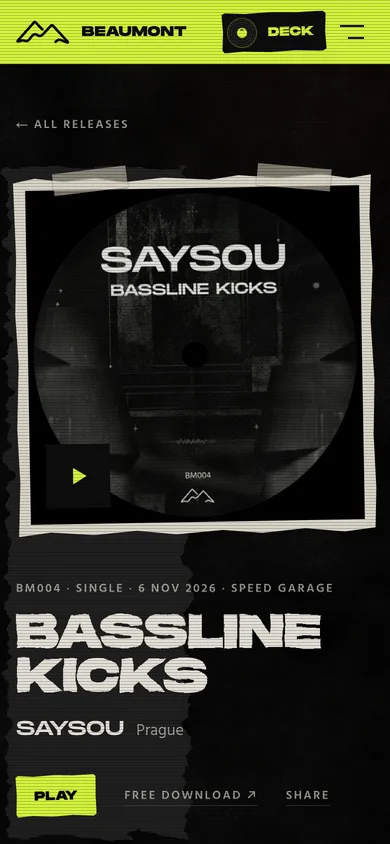
The label needed a home that felt like the music: UK underground, after dark and a bit rough around the edges, while still being easy to browse and listen to on a phone.
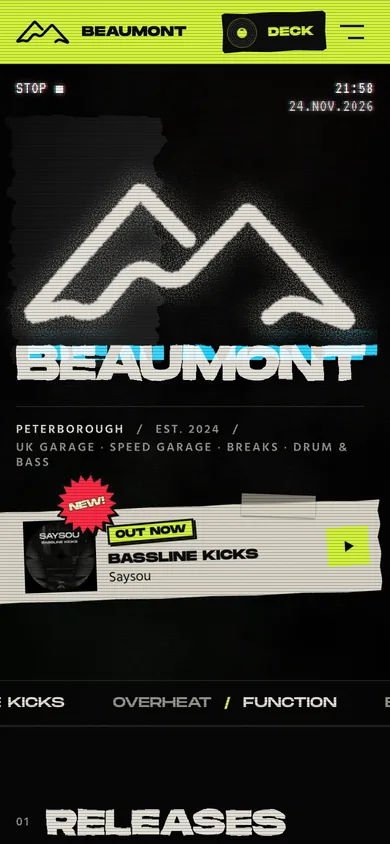
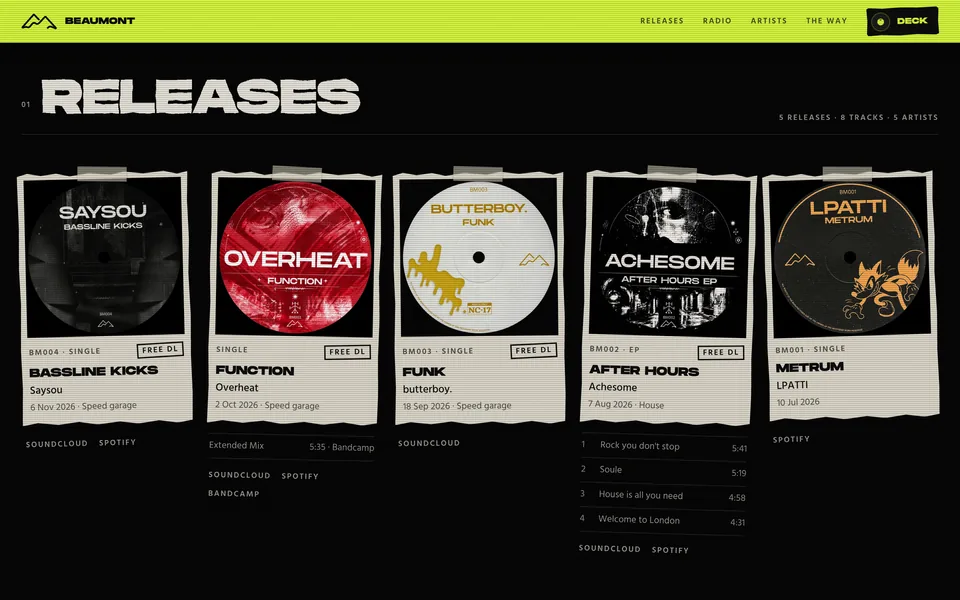
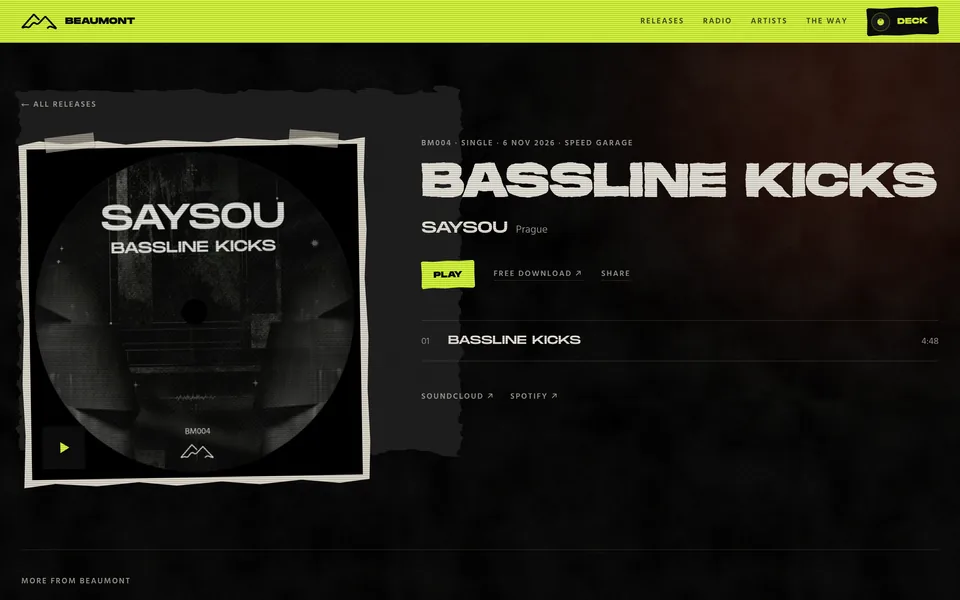
I built the look around a concrete wall. Releases are pasted onto it like posters, patches of it have been painted over, and the label's mountain logo is sprayed on with overspray and drips. I used rail-yard graffiti and tattoo flash sheets as references and held everything to the label's own brand guidelines. To keep the graffiti grown-up there are no bubble letters or graffiti fonts, and every texture is generated in code, so there is no stock imagery on the site. It only has a dark mode, because the brand's glow and texture rules only work on black.
A layer of VHS effects, such as tape tears, a tracking band and an on-screen display that follows the player, appears briefly and occasionally so it reads as a fault in the tape rather than a filter. All of it switches off for people who prefer reduced motion, and a stop button in the header pauses every animation on the site.
The deck
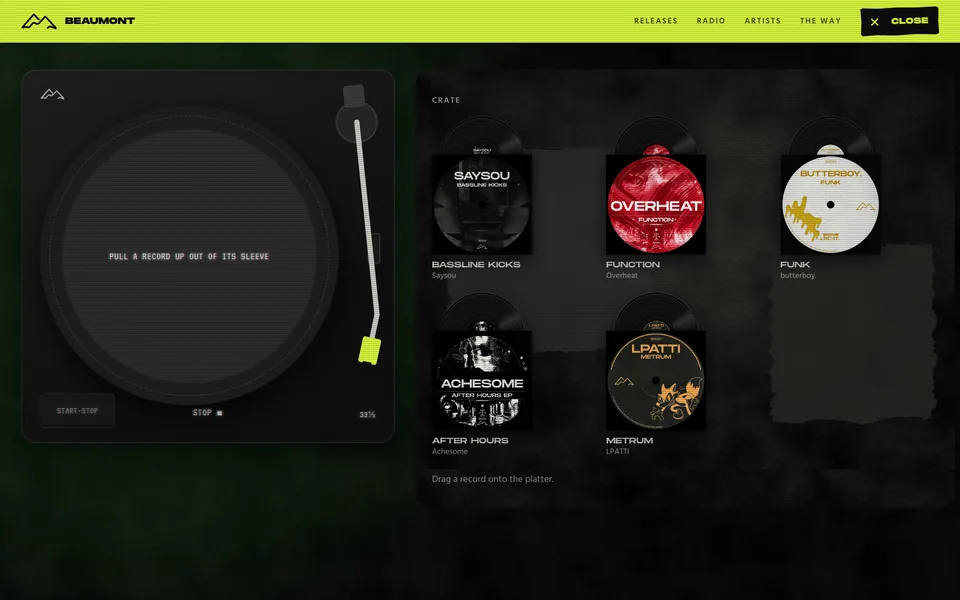
The deck is a turntable you can play. Pull a record out of its sleeve and it drops onto the platter and starts playing.
Real speeds
The platter turns at 33⅓ rpm, spins up quickly and slows down gradually, like a real deck when the power is cut.
Hands on the record
Holding the record stops the music. Spinning it and letting go moves through the track, and a harder flick moves further.
The tonearm is the scrubber
The arm tracks the song from the outer groove to the centre. Drag it to drop the needle anywhere, or lift it off to pause.
The light stays put
The reflection on the vinyl doesn't turn with the record, because in a real room the light isn't attached to it.
Honest about its limits
Spotify and Mixcloud can't be controlled from the page, so for those the arm stays parked rather than pretending to follow along.
An app on your phone
The deck can be installed as an app with a vinyl icon. Without a connection it shows a NO SIGNAL screen instead of a broken page.
Only real facts
The first prototype of the site was generated quickly and filled with particle effects, made-up events and made-up statistics. The rebuild removed all of it.
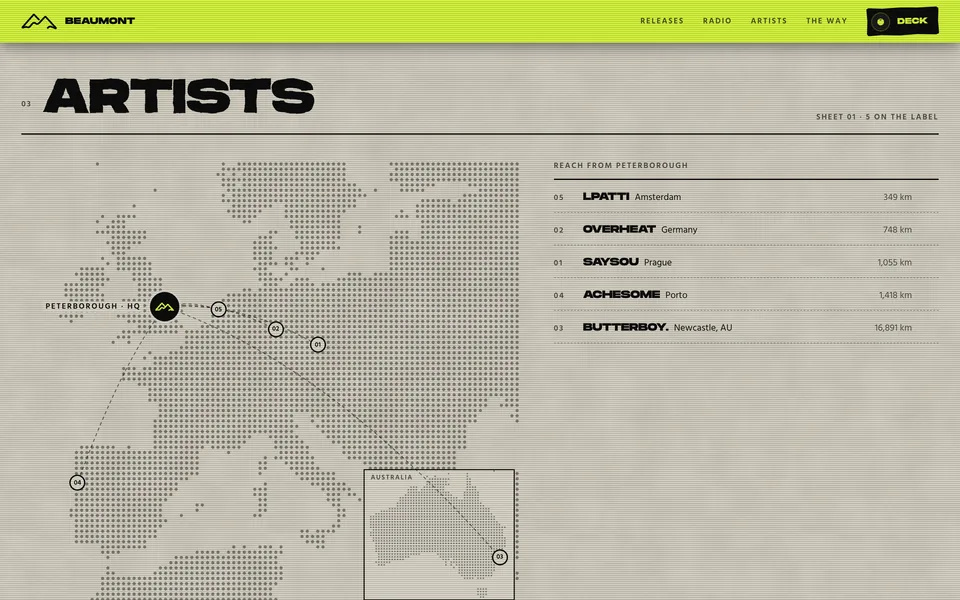
Catalogue numbers come from the sleeves, release dates from Spotify, genres from SoundCloud and artist locations only from public sources. Anything we don't know is left blank. For a small label, a made-up number does more harm than an empty space, and AI agents will fill any empty space they're given unless you stop them.
The player follows the same principle. SoundCloud tracks play through the site's own controls, sitting on top of a hidden SoundCloud player, so every play still counts for the artist.