Lab / Lab 02
The orchestrator and the harness
I wanted to find out how far AI agents could take a game on their own if the system around them was good enough. So I designed one with Claude: a lead session that planned and merged work, parallel workers that built it, and a set of checks that caught mistakes before they landed.
Why build it
Project Ship is a big game for one designer. The agents could write code quickly, but every session started from nothing, forgot what the last one had decided, and needed me to keep it moving.
The aim was a system that could keep working while I was at my day job or asleep, and still be safe to leave alone. That meant solving three problems. The first was continuity: each new session needed to know what the last one knew. The second was safety, because an agent with a terminal can do real damage to a machine. The third was quality, because code that compiles is not the same as code that works.
How it worked
Work moved from left to right, and every step had its own safety net underneath it.
A governor session read the project records, chose the next task and handed it to one of three lanes: worker agents, each in its own copy of the code, so they could build in parallel without touching each other's files. When a lane finished, the governor reviewed and merged its work.
Nothing important lived in a session's memory. The governor wrote a handoff note, kept my instructions word for word, and logged every decision and finding to disk, so a new session could pick up exactly where the last one stopped. Timers on the Mac nudged it every two hours, restarted it if it died, and replaced it with a fresh session every hour.
The hourly swap was about cost. An agent re-reads its whole conversation on every turn, so a long session gets more expensive with every step. Splitting the same 380 turns into four shorter sessions cut the tokens re-read from 65 million to 33 million.
What it caught
The safety nets worked. Over the month they stopped a long list of real problems before they reached the code or my machine.
Guards
Unsafe commands
Every command an agent ran was checked first. Deletions, wildcard process kills, searches that would have run for hours and anything touching my own browser were blocked, with the safe alternative written into the refusal.
Watchdog
Stalled sessions
One governor hung for 99 minutes on a search that wandered into my cloud drive. The watchdog restarts any session whose log goes quiet, and its first version taught us to tell a stuck session from one that is simply thinking.
Verification
Regressions
103 test suites, a soak test that ran eight copies of the game with a bot playing hundreds of raids, and statistical sweeps for balance changes. Screen captures were checked to make sure they could fail before anyone trusted them.
Budget
Runaway cost
In one week the agents used 95% of my allowance. A pacer now limits how many lanes run at once, and every agent call names its model, so the expensive ones are only used on purpose.
What it couldn't catch
By the end of August the game had procedural islands, fog of war, a build system, crafting, quests and an extraction timer. Nobody had played it end to end, and when I did, it wasn't fun.
Every check in the system measured something a machine can measure, so the agents optimised for exactly that. When I stopped it there were about 45,000 lines of game code and about 90,000 lines of tests and tools, and roughly two in five commit messages were about the checking machinery itself.
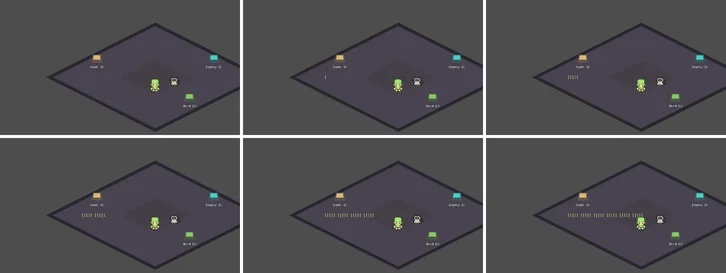
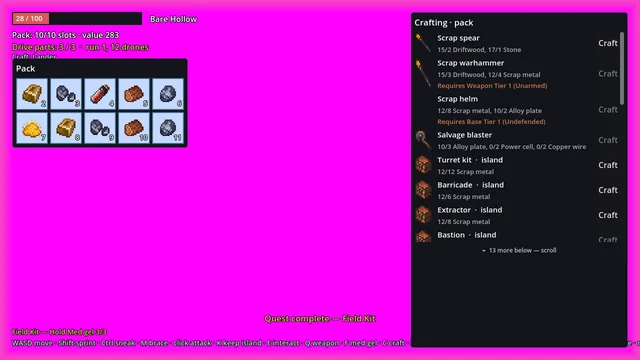
The images below are typical of the month. Fourteen frames were taken to prove that one fog effect fades in on time. Six more prove that a tally mark appears on the ship's floor after each run, and another screen was turned magenta so a panel's transparency could be measured. All of it was correct, and none of it made the game better to play.
You very much churn out features without creating scenes, scenarios, stories, world building and, fundamentally, a game.

What replaced it
I stopped the system on 10 September, redrew the game on paper, and restarted on 4 October with a person in the loop. I design and play; the agents engineer.
Every message I send is kept word for word and turned into a to-do list before anyone acts on it, so nothing gets lost in paraphrase. A lead session splits the work into tasks and hands them to parallel workers, each owning separate files. Each task comes back as one pull request, and it is only merged once the whole change has been read, the checks are clean and anything visible has been played. Each hand-back describes what I should notice when I play it, rather than what the code does.
A slice only starts when I have played the previous one. With that rule in place the work got faster rather than slower: on one day in October fourteen pieces of work merged, and about thirty more that night, each one played or looked at before it landed.
The harness I kept
The orchestrator is gone, but the safety nets it needed now protect every agent I run. I call this the harness: the environment that decides what an agent may do, what it knows when it starts, and what it must check before it says it's done.
I learnt early that written rules don't hold. An agent will read an instruction, agree with it, and still break it at two in the morning. So anything that must never happen is enforced by a guard that checks the command before it runs, and every guard has a clear allowed path, so agents aren't tempted to work around it.
The guards are tested like code. In August I found that three of six had no tests and printed nothing when they passed, which looks exactly like success. Now all six carry tests, 101 cases in total, and each test was shown to fail with its guard deliberately broken. While I was writing this page, one of them stopped me deleting two screenshots and told me to move them instead.
Beside the guards sit short standards that agents load before particular kinds of work, such as checking their own results or designing an interface, and a memory of one file per lesson learnt, so a mistake made once isn't repeated the following week.
One scheduled agent
The autonomy that survived is deliberately small: one agent, every two hours, working on the top item of a list I rank by hand.
Each run is capped at 90 minutes and 150 turns, writes one paragraph about what it did and sends one notification to my phone. If the task is finished or blocked, it waits until I look at it. There is a pause switch only I can clear, and a lock so two runs can never overlap.
What I learnt
- Automation optimises whatever you measure. If the measure is "tests pass", you get tests. The things that make a game good need a person to judge them, and that judgement has to happen often.
- Ask two questions before calling anything done. What does the player press to get here, and how would they know it happened? Both came from a memory system that passed 48 checks and was never connected to the game.
- Turn rules into mechanisms. Guards, gates and required files held up. Instructions in a document didn't.
- Test the safety net. A check that has never failed hasn't been tested. Prove it can fail before trusting it.
- Cost is part of the design. Session length, model choice and how much output an agent reads back all show up on the bill.